Kitsap County Jury Awards $30.17 Million Verdict to Deputy Amputee – Read More

Kitsap County Jury Awards $30.17 Million Verdict to Deputy Amputee – Read More
Get Help Now!
E-bikes have become increasingly popular throughout Washington, offering a convenient way to commute and travel. However, electric bicycles can also create serious risks because of their speed, weight, and the dangers of sharing the roads with other vehicles.
Electric bicycles combine the design of a traditional bicycle with an electric motor that can help riders travel at higher speeds with ease. E-bike riders are also exposed to the same traffic hazards as traditional cyclists, including distracted drivers, busy intersections, and vehicles turning across bike lanes.
Common causes of e-bike accidents include:
Because e-bike riders have little protection in a collision, accidents can cause serious and sometimes permanent injuries.
Common injuries for riders of electronic bicycles typically include:
Some injuries may not be immediately apparent after a crash. Seeking medical attention as soon as possible can help protect your health while also creating important documentation of your injuries to support your personal injury claim.
Liability for an e-bike accident depends on how the crash occurred.
If a motorist caused the accident, their auto insurance may cover the rider’s damages. Other sources of coverage may apply, including: personal injury protection (PIP), uninsured or underinsured motorist coverage, the rider’s automobile insurance, homeowners’ or renters’ insurance, or a dedicated e-bike insurance policy.
Determining liability and identifying all available insurance coverage can be complicated. Evidence such as photographs, witness statements, police reports, surveillance or dashcam footage, bicycle-camera footage, and the condition of the e-bike can help establish what happened and who may be responsible.
If an insurance adjuster contacts you after an e-bike accident, consider speaking with an experienced Personal Injury Attorney before providing a recorded statement or accepting a settlement.
The steps you take immediately after a crash can make a significant difference. You should:
Washington generally provides three years to file a personal injury lawsuit, although exceptions can apply. Evidence can disappear quickly after an accident. Nearby surveillance footage may be deleted, witnesses may become difficult to locate, and insurance companies may begin investigating immediately.
No two e-bike cases are the same. The value of a claim depends on the severity of your injuries, how the crash has affected your life, and the insurance coverage available. An experienced e-bike accident attorney can help you pursue the full range of damages Washington law allows.
Compensation in an e-bike accident case may include:
Because insurance companies often try to minimize these losses, it is important to document your injuries and expenses thoroughly and to talk with an attorney before accepting any settlement offer.
Washington recognizes three classes of electric-assisted bicycles.
Washington law also prohibits people under 16 from operating a Class 3 electric-assisted bicycle. No driver’s license is required to operate a qualifying electric-assisted bicycle.
To qualify as an electric-assisted bicycle in Washington, the bike must have a motor rated at no more than 750 watts. A vehicle that exceeds these power and speed limits is not legally an e-bike at all and may instead be treated as a moped or motorcycle, which can require a license, registration, and insurance.
Washington recently tightened this distinction. Engrossed Substitute Senate Bill 6110, which took effect June 11, 2026, amended the state’s e-bike statute to more clearly separate electric-assisted bicycles from electric motorcycles — a response to increasingly powerful vehicles being marketed as e-bikes.
It’s a fair question. Today’s most powerful e-bikes can reach speeds and carry a mass that rival small motorcycles, yet they face far less regulation. Many riders, safety advocates, and lawmakers argue that vehicles capable of motorcycle-like speeds should carry motorcycle-like responsibilities, and there is a reasonable case for treating them that way.
Under current Washington law, however, a true electric-assisted bicycle is not a motorcycle. As long as it stays within the 750-watt limit and the 20- or 28-mph assistance cutoffs, it is legally a bicycle, with no license or statewide helmet mandate. This distinction is important in the event of a crash, because it shapes which insurance coverage applies and how liability or fault for the accident might be determined.
The 2026 amendments to the e-bike statute were aimed squarely at this gray area, drawing a sharper boundary between bikes that qualify and higher-powered vehicles that are really motorcycles in disguise.
Do I have to wear a helmet on an e-bike in Washington?
Washington does not have a statewide helmet law. Some cities and counties have their own helmet ordinances, so requirements vary depending on where you ride. Regardless of local law, a helmet is one of the most effective ways to prevent a serious head injury, and choosing not to wear one generally will not bar you from recovering compensation when another party caused your crash.
Do I need a license or insurance to ride an e-bike?
No. Washington does not require a driver’s license, registration, or motor vehicle insurance to operate a qualifying electric-assisted bicycle. Optional coverage, such as a homeowners’, renters’, or dedicated e-bike policy, can still help after an accident.
Who pays if a driver hits me while I’m on my e-bike?
If a motorist caused the crash, their auto liability insurance is usually the primary source of compensation. Depending on the circumstances, your own personal injury protection (PIP), uninsured or underinsured motorist coverage, or other policies may also apply. Identifying every available source of coverage is one of the most valuable things an attorney does.
How long do I have to file an e-bike accident claim in Washington?
Washington generally gives you three years from the date of the accident to file a personal injury lawsuit, though certain exceptions can shorten or extend that window. Because evidence disappears quickly, it is best to speak with an attorney as soon as possible.
Is an e-bike treated like a motorcycle after an accident?
Not if it meets the legal definition of an electric-assisted bicycle. A qualifying e-bike is treated as a bicycle under Washington law. A vehicle that exceeds the 750-watt or speed limits may fall outside that definition and be treated more like a moped or motorcycle, which changes the rules that apply to your claim.
An e-bike accident can leave you dealing with serious injuries while an insurance company is trying to determine how little it can pay.
At Davis Law Group, our personal injury attorneys understand the laws and insurance issues involved in bicycle and e-bike accidents. We can investigate your crash, preserve evidence, communicate with insurance companies, and fight for the compensation you deserve.
If you or someone you love was injured in an e-bike accident, call Davis Law Group at 206-727-4000 for a free consultation.
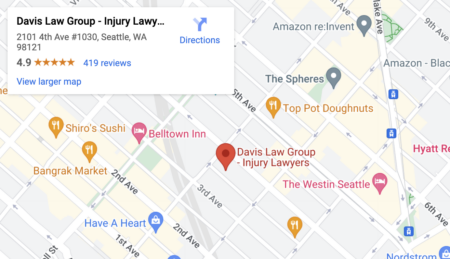
2101 4th Ave #1030,
Seattle, WA 98121
Phone: 206-727-4000
Office Hours:
24 hours/day. 7 days/week.
Phone:
Contact Us
Complete this CONFIDENTIAL form or call 206-727-4000 for a FREE consultation.