$49.33 Million Settlement Reached in Starvation Death of Autistic Vancouver Child – Read More

$49.33 Million Settlement Reached in Starvation Death of Autistic Vancouver Child – Read More
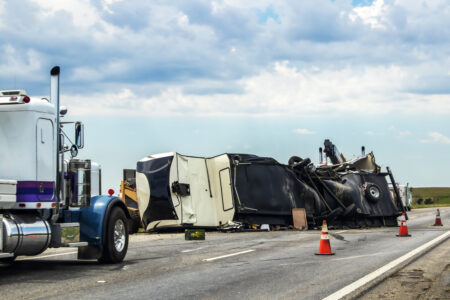 On April 12, 2026, CBS News’ 60 Minutes aired an eight-month investigation into chameleon carriers — commercial trucking companies that rack up safety violations, dissolve, and reopen under new names with clean records. The same trucks, the same drivers, the same danger — but on paper, a brand-new company with no history of crashes or violations.
The investigation revealed that carriers connected to one network alone logged nearly 15,000 safety violations and 500 accidents in just two years. Risk assessment data shows chameleon carriers are four times more likely to be involved in severe crashes. In 2024, more than 5,300 people died in truck-related crashes nationally.
The question at the heart of this issue is: who’s really driving? Who is behind the wheel? Who is behind the company? And who is hiding behind shell entities to avoid accountability? If you are hurt, who is driving your case forward? For anyone sharing Washington’s highways with commercial trucks, the answers matter.
Starting a trucking company in the United States takes as little as $1,000 and 21 days. There is no requirement that the owner be a U.S. citizen — networks based in Eastern Europe, Central Asia, and India operate carriers across the country with no meaningful physical presence. The FMCSA, the federal agency overseeing all 700,000 trucking companies, has only about 350 investigators to monitor the entire industry.
Chameleon carriers exploit this gap. When a carrier accumulates too many violations, the principals dissolve it and register a new company at a new address — often a “ghost office” that exists only on paper. The old DOT number and its violation history disappear. The 60 Minutes investigation showed the same truck operating under six different carrier names in a single year. Drivers have reported being told to cover their truck’s DOT number with duct tape and a printout of a new one. At the more sophisticated end, networks use tools that falsify electronic driving logs and fabricate compliance documentation.
The problem extends beyond the carriers themselves. Fraudulent commercial driving schools — known as CDL mills — issue licenses to unqualified drivers who are then placed behind the wheel by chameleon operations. In February 2026, a crash in Indiana killed four people. The driver held a non-domiciled commercial license and was tied to a network of interconnected chameleon carriers. FMCSA immediately expanded its investigation to include the driving school and has since launched nationwide in-person audits of CDL schools.
Chameleon carriers also exploit their own drivers. The 60 Minutes investigation revealed that drivers were lured with promises of $8,000 to $12,000 per week, only to have their pay systematically reduced through excessive fees. A class action lawsuit alleges the network misclassified drivers as independent contractors and violated minimum wage laws. Financially coerced drivers are more likely to be pressured into violating hours-of-service regulations and operating unsafe equipment — compounding the risk of catastrophic trucking accidents.
Trucking accidents are fundamentally different from standard car accidents. A fully loaded tractor-trailer can weigh 80,000 pounds, and collisions with passenger vehicles almost always result in catastrophic injuries or death. But the legal complexity goes beyond the severity of injuries.
A single trucking accident may involve liability from the driver, the carrier, the broker, the shipper, the truck manufacturer, and the maintenance company. In chameleon carrier cases, identifying the actual principals behind the operation adds another layer — the corporate structure is deliberately designed to obscure ownership. Insurance coverage is equally complex: federal regulations require minimum coverage, but the actual amount available depends on the carrier’s policy limits, its operating authority, and whether the carrier’s identity at the time of the crash matches the carrier on the insurance policy.
Critical evidence — electronic logging device data, driver qualification files, vehicle inspection records, dispatch communications, and dashcam footage — can be lost or deliberately destroyed if not preserved immediately. Chameleon carriers have an even greater incentive to destroy evidence because their entire business model depends on erasing their history.
The federal government is beginning to respond. FMCSA is hiring additional investigators, rolling out a modernized registration system, and Congress has introduced the Safety and Accountability in Freight Enforcement (SAFE) Act to help identify bad actors before they begin operating. But regulatory reform moves slowly, and chameleon carriers continue to cause serious trucking accidents today. For drivers on Washington’s busiest corridors — I-5, I-90, I-405, SR-99 — the risk is immediate. Commercial trucks from every state and dozens of countries travel through Washington daily, and there is no practical way for the public to know which carriers are legitimate and which are chameleon operations hiding behind a new name.
Trucking companies and their insurers know which law firms will actually take a case to trial and which will settle for whatever is offered. High-volume firms that never intend to file a lawsuit — sometimes called “settlement mills” — get lower offers because the insurance companies know there is no real threat of litigation. In chameleon carrier cases, where the corporate structure is designed to deflect liability, a firm that is not prepared to litigate will leave significant compensation on the table or fail to identify all responsible parties in the first place.
For more than 30 years, the attorneys Davis Law Group have investigated and litigated serious injury and wrongful death cases in Washington State, including complex trucking accident claims against carriers, brokers, shippers, and their insurers. Attorney Chris Davis and his team take immediate steps to preserve evidence, trace the carrier’s corporate history and prior identities, identify every liable party and insurance coverage layer, and build cases that are ready for trial. When Davis Law Group is on the other side, the carriers and their insurers know they are dealing with attorneys who will litigate — and that changes what they are willing to offer.
Note for Ian: Structure for FAQ schema markup.
A chameleon carrier is a trucking company that shuts down after accumulating safety violations or enforcement actions and reopens under a new name and DOT number. The same trucks and drivers continue operating under the new identity with a clean record. Some chameleon operations run networks of multiple carriers simultaneously, shifting freight between DOT numbers to avoid detection.
Yes. Victims of trucking accidents caused by chameleon carriers can pursue claims against the carrier, its principals, the driver, and other responsible parties. These cases are particularly complex because the corporate structure is designed to obscure ownership, which is why experienced legal representation is critical.
Call 911 and seek immediate medical attention, document the scene and the truck’s markings (DOT number, carrier name, license plate), do not give a recorded statement to any insurance company, and contact an experienced trucking accident attorney immediately. Evidence in these cases can be lost or destroyed quickly, especially when a chameleon carrier is involved.
The statute of limitations for personal injury and wrongful death claims in Washington is generally three years. However, critical evidence in trucking accident cases can be lost very quickly, so contacting an attorney as soon as possible is essential to preserving your claim.
If you or someone you love has been injured in a trucking accident in Washington State, contact Davis Law Group at (206) 429-7176 for a free consultation. You can also request a free copy of Chris Davis’s book on trucking accident claims at WashingtonAccidentBooks.com. The consultation is free, and you pay nothing unless we recover for you.
Office Hours:
24 hours/day. 7 days/week.
Phone:
Contact Us
Complete this CONFIDENTIAL form or call 206-727-4000 for a FREE consultation.